Whatwedo
Three kinds of work, two ways to deliver it.
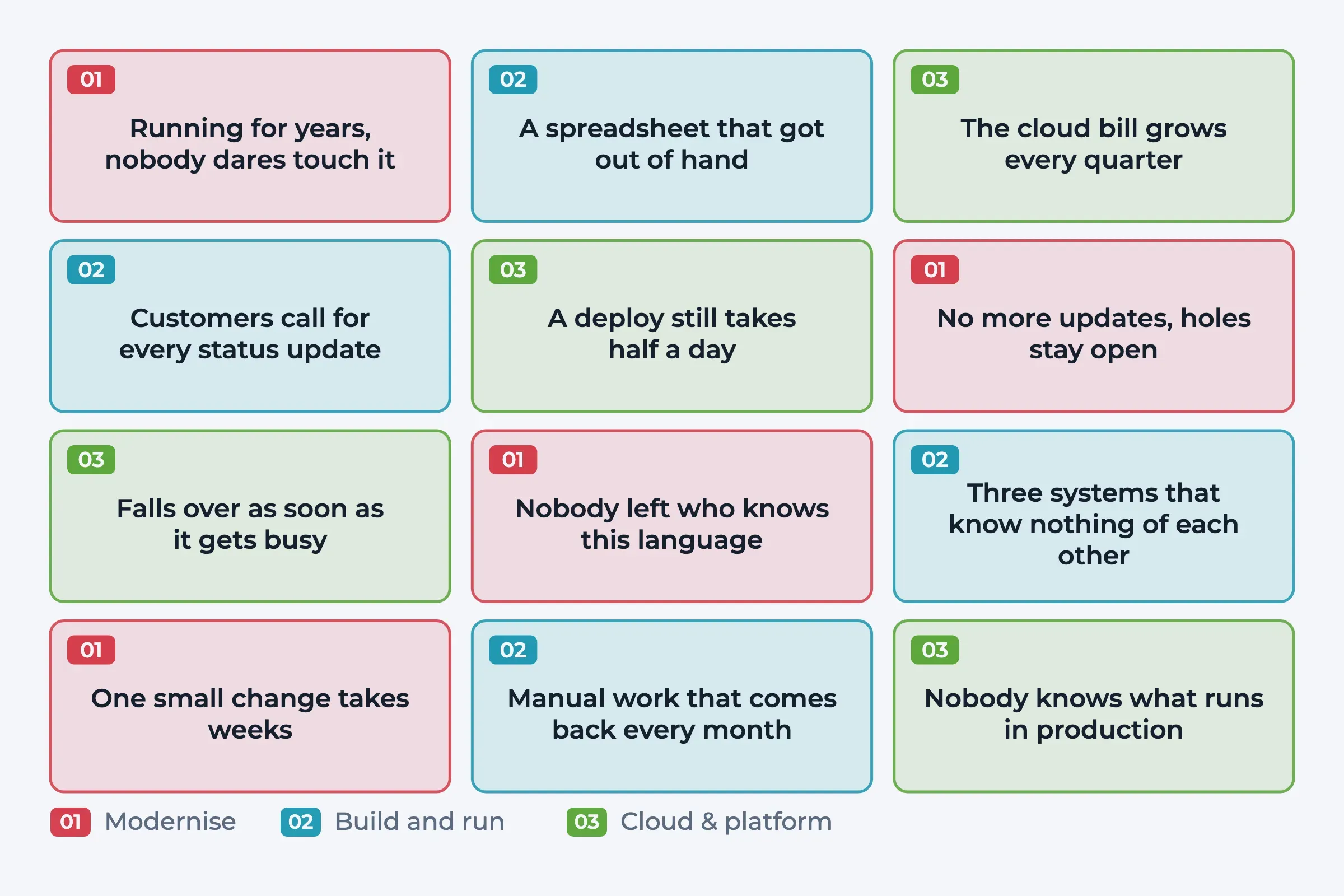
What people bring to us almost always falls into one of three categories: something has to be built that does not exist yet, something old is causing pain, or something is running that has to run better. More and more often that last one is software someone else built, which we take over, run and develop further. Build or run: we do it, or we strengthen the team you already have.
Three ways we help you forward
Modernise legacy systems
Legacy nobody dares to touch any more. Sometimes we rebuild. More often we take it over first and renew, step by step, whatever hurts most. No big bang, no standstill.
Often only the version fell behind, not the language
Reversible per step, not everything in one weekend
Also when another party built it
Build and run custom software
Applications that follow your process, not the other way round. From first sketch to production, and after that we keep them running and develop them further.
A web application, an app, a customer portal or an API integration
Build new, or run and extend what already exists
Source code and documentation are yours
Cloud & platform
The foundation everything else runs on. Landing zones on AWS and Google Cloud, CI/CD and observability. We set it up, and we keep it running.
Migration without downtime or surprises on the bill
Cost, security and governance from day one
Managed cloud on its own, if the building is already done
Webuildit,orwebuildwithyou
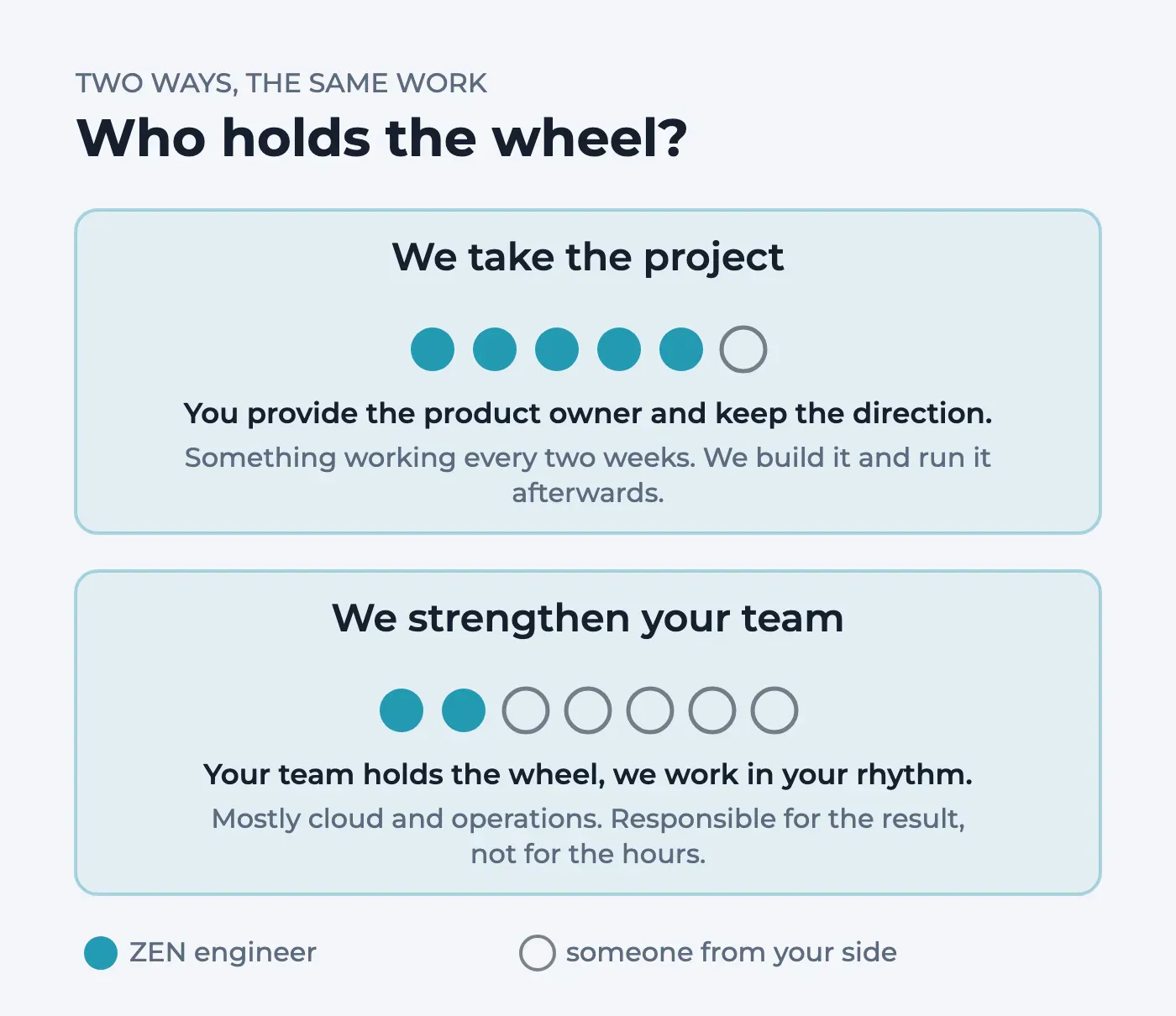
With each of the three above you can go two ways, and the difference is not in the work but in who holds the wheel.
- We take the project. Our own team, a product owner on your side, and something working to look at every two weeks. You keep the direction, we do the delivery and the running afterwards.
- We strengthen your team. Senior engineers who work in your own rhythm. Not to add hands, but because someone is needed who dares to point at the architecture or knows why the pipeline falls over every Friday.
The second form is mostly cloud and operations with us. How staff augmentation works.
Stillfindingyourbearings?
Sometimes the question is not yet "who builds this" but "should this be built at all". Manual work that keeps coming back, an export someone makes by hand every Monday, three systems that know nothing about each other.
Start by working out what it costs you and what it would save. That usually ends in one of two directions: the system you have is due for renewal, or something new has to come.
Whatwebuildourselves
We are not an agency that only works for others. Four of our own products run in production, and what we learn there goes into the work we do for you.
- Agile Analytics — DORA and SPACE, team interviews and time spent in one view.
- Keana — green city logistics.
- CyberCloud Voice Analytics — searchable voice data with compliance and retention.
- Zenthropic — AI phone agents.
Allservicesataglance
Modernise legacy systems · Legacy software modernization
Build and run custom software · Custom software development · What custom software costs
Cloud & platform · Cloud consultancy · Cloud & DevOps scan · ZEN Cloud Landing Zone · ZEN DevOps Accelerator · Content at any Scale
How we deliver · Staff augmentation · AI solutions
Frequently asked questions
I do not know yet which of the three my question falls into.
You do not have to. In a half-hour conversation it is usually clear whether it is about renewing, building new or the foundation underneath, and often the answer is a combination: first the cloud side in order, then the system on top of it.
Can you also just supply people?
+
Yes. We call that staff augmentation: senior engineers who work in your team and your rhythm, mostly on cloud and operations. The difference with contracting as you know it is that they are responsible for the result, not for the hours.
Can you take over software someone else built?
+
Yes, and that is the question more and more often. The first sprint is reading in: source code, environment and what happens in production. After that we run it per month and pick up changes in sprints. Rebuilding is usually not needed, often only the version fell behind.
What does it cost?
+
In sprints of two weeks: small €4,000, medium €8,000, large €12,000, excluding VAT. After every sprint there is working software and you decide about the next one. Hosting and managed services per month are listed separately in the quote. The reference sizes are on what custom software costs.
What are you up against?
Describe briefly what runs and where it hurts. You get back which of the three directions we see it in, and what the first step would be.