Cloudconsultancy
To the cloud without downtime, and without surprises on the bill.
The cloud is rarely the goal. The goal is that you can deliver faster, that it does not fall over when it gets busy, and that you know what it costs. We are a certified Google Cloud Partner and work just as well on AWS: we guide the migration, set up the foundation, and keep running it afterwards.
Wherecloudmigrationsbreakdown
Almost never on the technology. Four things keep coming back:
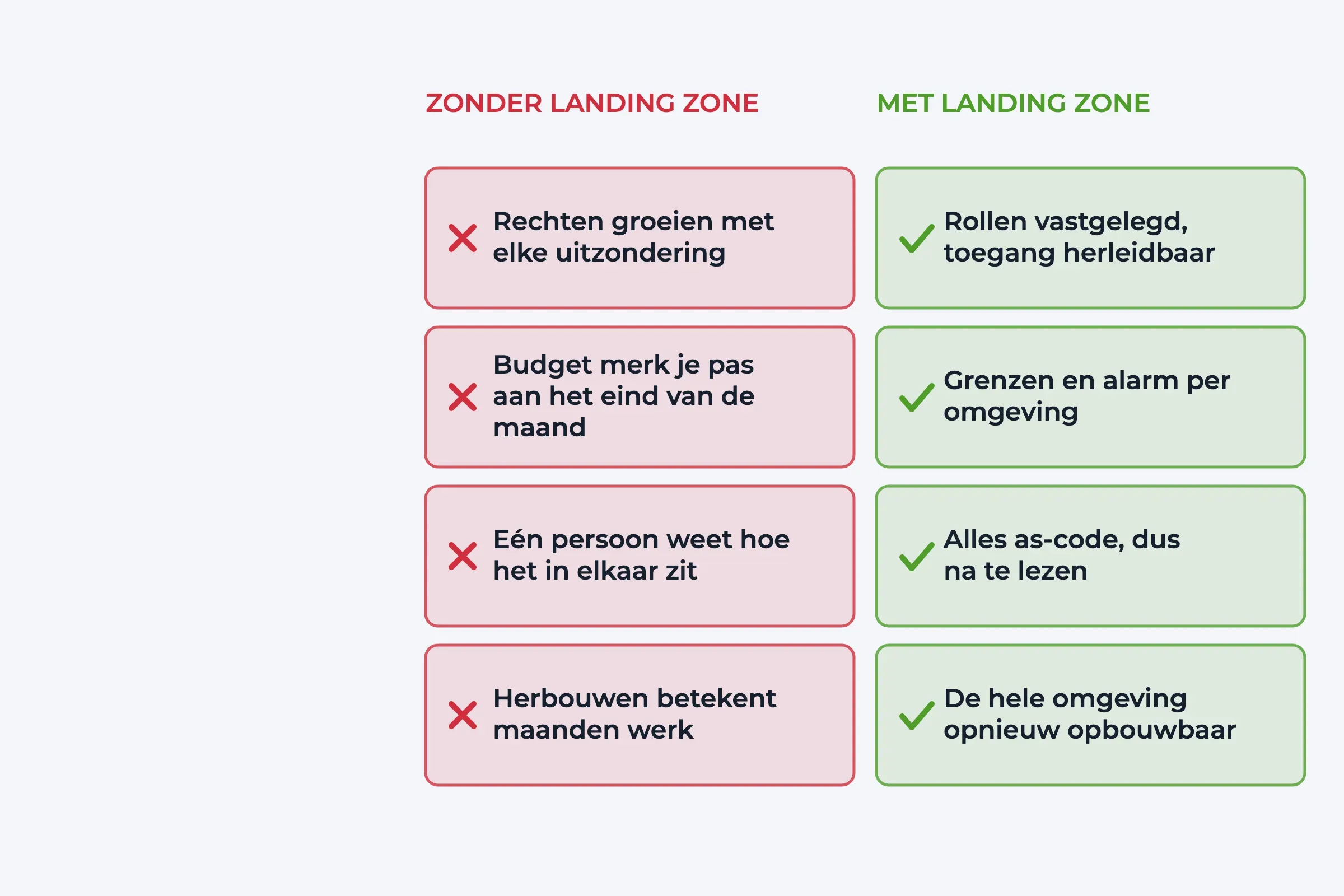
- The bill. You pay for what you switch on, not for what you use. Without budget limits and without someone looking at it monthly, it quietly climbs.
- A lift-and-shift that stays. The machines move unchanged and then there is no time for the second step. You get the downsides of both worlds.
- Permissions nobody oversees any more. IAM grows with every exception, until nobody can say who can reach what.
- One person who knows. Works fine until that person goes on holiday.
Thelandingzone:fourlayers
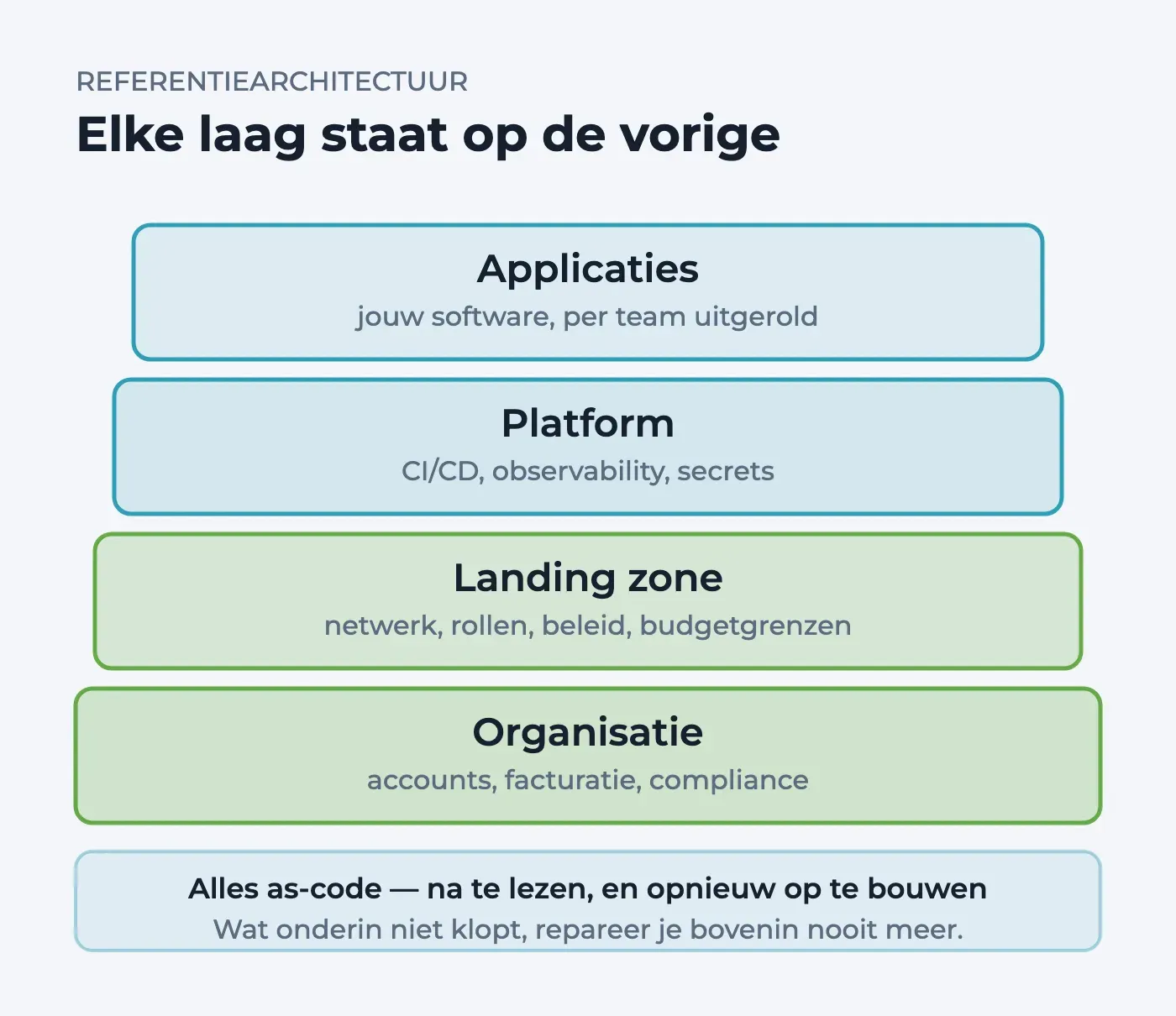
A landing zone is the environment your applications land in: set up before anything moves, instead of built around it after things went wrong. Our reference architecture has four layers, each with its own development cycle.
Everything is delivered as code: environments, permissions, network, policy. Not tidy for the sake of tidy; it is what gets you through an audit and what lets you rebuild the whole environment if you have to. See the ZEN Cloud Landing Zone.
Migratingisthestart,nottheend
The months after the migration decide whether it succeeded. That is our work just as much: CI/CD that does not fall over every Friday, observability so you see an outage before a customer calls, and a look at the bill every month.
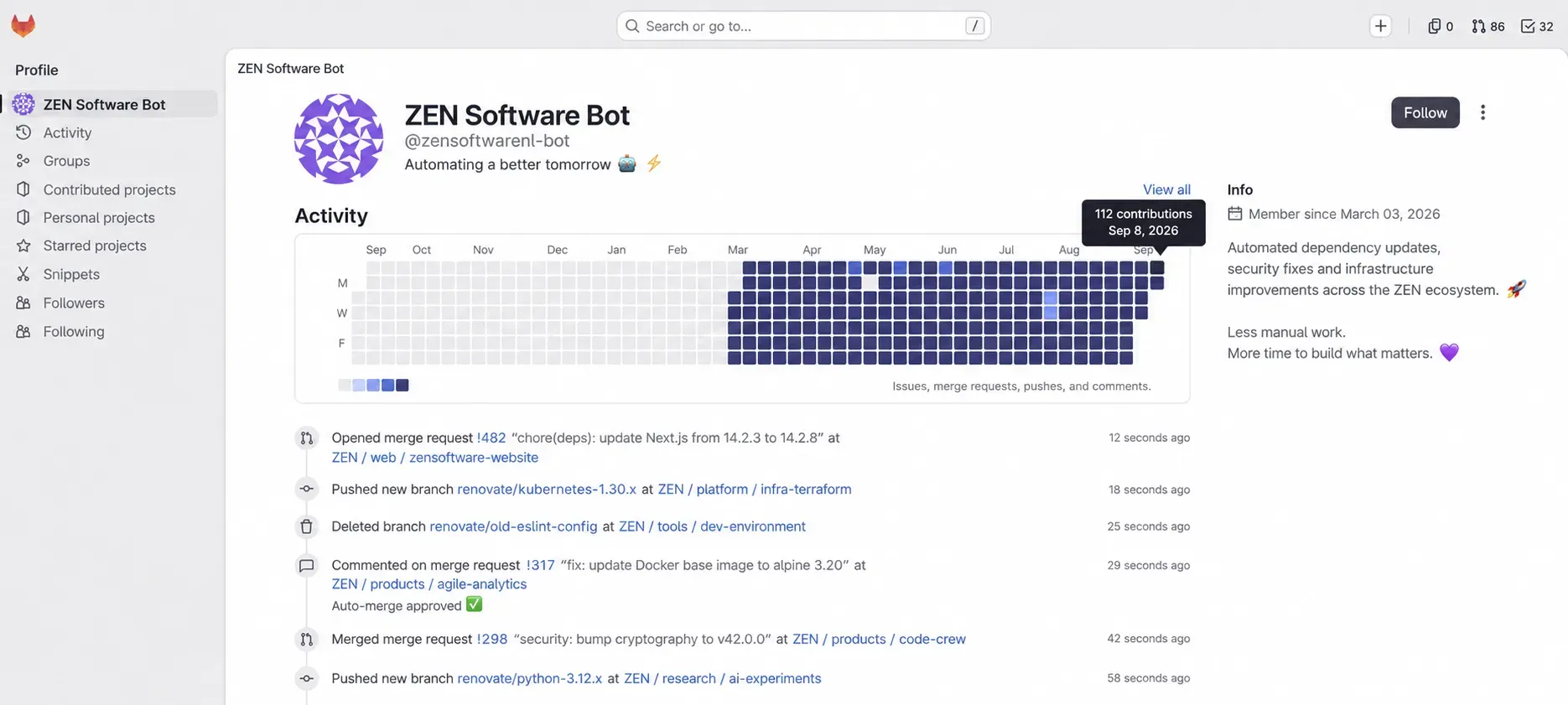
Next to this is the GitLab profile of our own bot: on 8 September, 112 actions in one day. Dependency updates, a security bump of cryptography, a branch for the next Kubernetes version. Work nobody did by hand, and that would all have been left lying without this automation.
We work with the vendors' own frameworks, AWS Well-Architected and the Google Cloud Architecture Framework, because then you can measure where you stand instead of arguing about it. Want only this part, without a migration? That works too.
Alreadyinthecloud,butitcouldbebetter?
Many companies have run in the cloud for years and are not happy with it: the bill keeps growing, deployments stay nerve-racking, and when something falls over nobody knows where to look. We do that work too, without a migration:
- Kubernetes and GKE. Clean up clusters, autoscaling that works, upgrades without downtime.
- Deployments and CI/CD. From "no deploys on Friday" to several a day, with a rollback you trust.
- Observability and SRE. Logging, metrics and alerting that show the cause, not just the symptom.
- Cost (FinOps). What you pay against what you use, and what you can switch off without risk.
Want to know where you stand first? The Cloud & DevOps scan gives you a prioritised list of improvements in 5 days, for €4,000 excluding VAT.
Managedcloud:from€950permonth
Once it runs, we keep it running. Managed cloud costs from €950 per month, or 10% of your cloud spend if that is higher. Excluding VAT, cancellable monthly. Included:
- Monitoring and alerting. We see an outage before your customer calls.
- Cost control. A monthly look at the bill, with budget limits that raise an alarm.
- Updates and patches. Kubernetes versions, libraries, security fixes.
- Agreed response times. How fast we respond to an outage and to a question is in the agreement, so you know where you stand.
That is during office hours. 24/7 on-call is available on request, as a separate agreement on top of the base fee. Unplanned work and outages fall under managed cloud; planned improvement work on infrastructure and CI/CD goes in sprints.
GoogleCloudPartner
We are a certified Google Cloud Partner. That means Google has assessed our engineers and our projects, and that for environments on Google Cloud we can apply to the partner programmes: sometimes a scan or a migration is partly funded from them. And we work just as well on AWS; which cloud it becomes depends on what you already have.
Orwereinforceyourownteam
Already have people on cloud and operations, but something is missing? Then we join in instead of taking over. On this ground that is our usual form: senior engineers in your rhythm, responsible for the result.
How project reinforcement works · Cloud migration and DevOps coaching at ANWB
Frequently asked questions about cloud
Is the cloud right for my organisation?
For almost every organisation, yes. Most of the regulatory objections from ten years ago have been resolved, and very few parts of a business are genuinely barred from the public cloud. So the question is rarely whether the cloud fits, but which part goes first and at what pace. We work that out in an intake.
How do I become a cloud-ready organisation?
+
We start with an intake of your business processes and, more importantly, your technical infrastructure. Do you already use the cloud, and if so which one and where in the business? Then we look at how much still runs on virtual machines or VPSs. Based on that we propose a series of steps and smaller intermediate steps. You do not have to take them all: how far you go depends on how big a change you want.
Where it usually goes wrong along the way is in why most cloud migrations fail before the first deployment. Already running in the cloud? Then the Cloud & DevOps scan is the shorter route.
Which cloud platform suits my organisation best?
+
That mostly depends on what you already have and where you want to go. If you work a lot with Microsoft 365 and Entra ID, Azure is the obvious choice. If it is about data, analytics and AI, Google Cloud is often the strongest option. AWS has the widest range of services and the largest ecosystem. European sovereignty is not decisive for most companies; for government and some regulated sectors that may change.
For completeness: ZEN Software is a Google Cloud Partner. We are because we like working with Google, and data and AI are focus areas for us that have a special place there. We like working with AWS just as much. Azure we can do too, but our heart is not in it. We recommend the platform that fits your situation, not the platform we partner with; in the intake that choice usually surfaces within a few days.
What is cloud native, and should I use it?
+
Cloud native means software built for the cloud: containers, managed services, automatic scaling and everything as code. Not every application needs it. Moving an existing application onto a virtual machine in the cloud first is a perfectly good first step; cloud native pays off mainly where you change things often or need to scale quickly. We wrote a separate piece about the difference with "native cloud".
What is the difference between SaaS, PaaS, IaaS and Containers as a Service?
+
The difference is in how much you manage yourself. With IaaS you rent infrastructure (servers, storage, network) and manage everything from the operating system up yourself. With PaaS you only supply your code and the provider runs the platform. SaaS is ready-made software you use in the browser. Containers as a Service sits between IaaS and PaaS: you supply containers and the provider runs them, for example through managed Kubernetes.
What does a cloud migration cost?
+
One application to the cloud costs €4,000 to €16,000: one or two sprints of two weeks. A landing zone with the first applications on it is two to three medium sprints, €16,000 to €24,000. A complete platform is a series of large sprints you steer per application. Hosting and managed cloud per month we work out before the migration. See what custom software and cloud migration cost.
Do we have to move everything at once?
+
No, and it is usually unwise. We set up the landing zone first and then move per application, so you can fall back at every step. What goes last is usually what is most sensitive.
Can you do just the managed cloud?
+
Yes. Managed cloud costs from €950 per month, or 10% of your cloud spend if that is higher, excluding VAT. That covers monitoring, alerting, cost control, updates and agreed response times during office hours; 24/7 on-call is available on request. You do not need to have had anything built by us first.
Can infrastructure work be done as a sprint?
+
Yes. Improvement work on infrastructure and CI/CD runs in sprints, with a sprint goal that is done after two weeks: a pipeline that deploys reliably again, a cluster that has been cleaned up, a landing zone that stands. Only the medium (€8,000) and large (€12,000) sprint, because infrastructure work rarely fits in a small one. Unplanned work and outages are not sprints; they fall under managed cloud.
What do cloud consultancy or project reinforcement cost per hour?
+
Senior cloud and platform engineers cost €130 to €165 per hour, excluding VAT, depending on role and commitment. That is the form for work that does not fit in a sprint: joining your team, an architecture question, guiding a migration. For well-defined work a fixed-price sprint is usually cheaper.
What are the latest cloud trends?
Not every trend, but the ones that matter: Standup & Deliver, ZEN Software's newsletter, is about measuring software development and production platforms. In other words, whether your platform and your team are actually getting better.
What runs now, and where do you want to go?
Send us what runs at the moment and what is not going well. You get back whether it is a migration question, a foundation question or a managed cloud question, and what the first step would be.